This guide is informational. Always verify how the rules apply to your specific case.
You are here: At work → Safety representatives and incidents
The guide belongs to At work. It is for the situation where something almost goes wrong, where the boss says “don’t write an incident report, it looks bad,” or where there is no safety representative at all. Start with document first if the timeline does not already exist.
Incident, accident, and report to AV
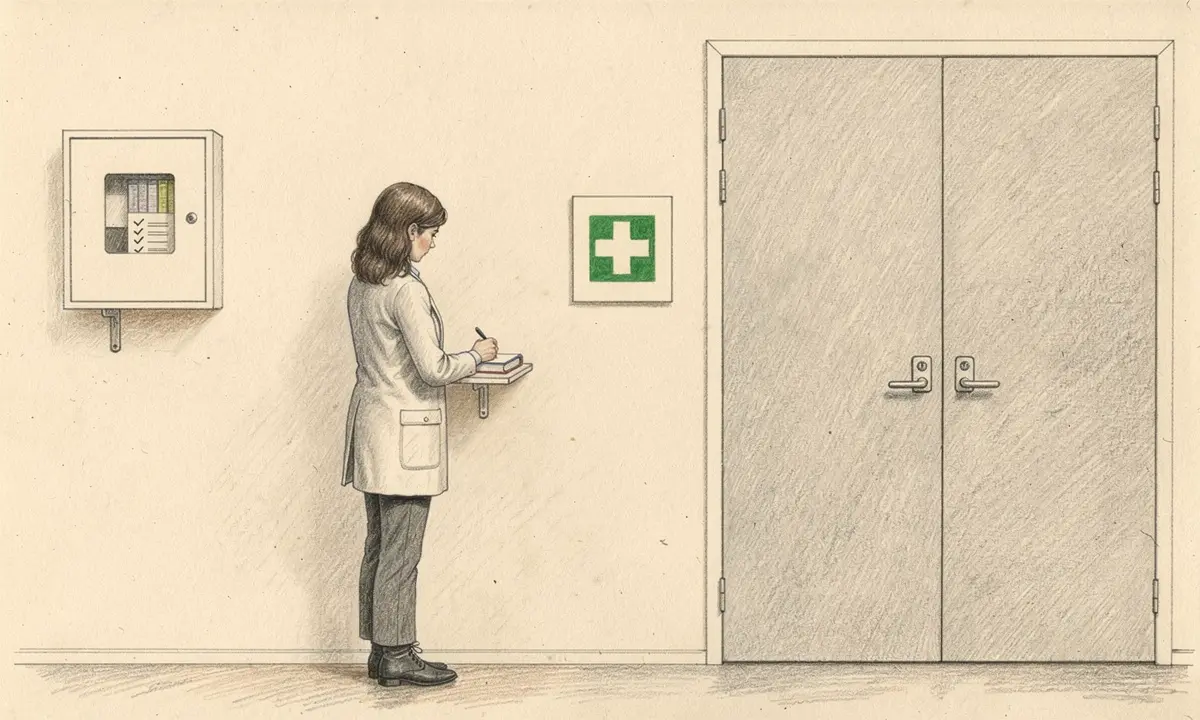
A slippery floor, a near-collision with a forklift, a customer who grabs the throat but lets go, an IT system that almost releases records: these are incidents. If it only remains in the boss's memory, it becomes “nothing happened.” Your report is what forces the employer to investigate according to systematic work environment management.
Template Mini-template: incident report
Subject: Incident [date] [brief event]

I report an incident on [date] at [time] at [location].

What happened:
1. ...
2. ...

Who was there: ...
What almost happened: ...
Previous similar incidents (if I am aware): ...

I request written confirmation that the incident has been received, that it is being investigated, and that the safety representative is informed.
Copy to safety representative/regional safety representative: [name].
Safety representative: who appoints, what they can do
At a workplace where at least five employees are regularly employed, one or more safety representatives (work environment representatives) must be appointed from among the employees. Representatives should also be appointed at smaller workplaces if the working conditions require it. If there are multiple representatives, one should be the chief safety representative.
Safety representatives are appointed by the local employee organization that is or usually is bound by a collective agreement with the employer. If there is no such organization, the representative is appointed by the employees. The representative represents the employees in work environment matters – even those who are not union members.
The task is to ensure that the employer prevents ill health and accidents, to participate in the planning of new premises, work methods, and changes in working hours, and to receive the documents and time needed. The employer must give safety representatives and employees the opportunity to participate in systematic work environment management.
A safety committee must exist where at least 50 employees are regularly employed, and also at smaller workplaces if the conditions require it. The committee is the cooperation body. It does not replace the safety representative's right to act in individual cases.
Regional safety representative
If there is no safety committee, a local union branch may appoint a regional safety representative from outside the group of those working at the site. The condition is that the branch has at least one member at the workplace. A regional representative has essentially the same tasks and powers as a local safety representative and represents the employees regardless of union affiliation where a local representative is absent.
If there is a local representative, a regional representative can still be involved as support, as long as there is no safety committee that blocks the assignment. This is often the point: someone who is not employed at the site can demand measures without sitting in the same break room as the manager the next day.
Request for Measures and Safety Representative Stop
If the safety representative believes that measures are needed for a satisfactory work environment, the representative should turn to the employer. The representative can also request that an investigation be conducted. The employer must immediately provide written confirmation that the request has been received and promptly provide a response. If this is not done, or if the request is not considered within a reasonable time, the representative can go to the Swedish Work Environment Authority and request an injunction or prohibition.
In the event of an immediate and serious danger to life or health, the safety representative can halt work (safety representative stop) until the Swedish Work Environment Authority has made a decision. It is the ultimate tool, not a way to win a salary negotiation. If the stop is abused, it can be turned against the representative. If used correctly, it is legal protection, not disobedience.
When the manager obstructs the representative
The employer may not obstruct the safety representative from fulfilling their duties. Anyone who suffers damage from such an obstruction may be entitled to damages. Reprisals against those who report incidents, participate in safety work, or engage a regional representative should be treated as a separate matter: timeline, emails, witnesses. See document and if the next step is a warning or relocation: warning and relocation.
Breaks, pauses, and rest rooms that do not function are also work environment issues: break, rest, and pause. The papers in employment, the union, and what LAS requires in writing: collective agreement and employment certificate.
Frequently Asked Questions
Do I have to be a union member to have a safety representative?
No. The representative represents the employees at the site. However, it is usually the union that appoints the representative, and a regional safety representative requires that the appointing department has at least one member there.
Who reports serious incidents to AV?
The employer. This does not prevent you, the safety representative, or the regional representative from reminding in writing about Chapter 3, Section 3 a, and contacting AV yourself if the employer remains silent.
Can the manager move the incident to “improvement proposal”?
Not as a way to avoid investigation. Request that the incident be recorded as an incident and that the safety representative be informed. An improvement proposal without investigation is not SAM.
Can I stop work myself?
The individual employee should not expose themselves to immediate danger, but the safety representative stop in Chapter 6, Section 7 is the representative's tool. Leave the area if it is dangerous, alert, write the timeline, and get the representative on site.
Sources
Checked: 15 September 2026.
- Work Environment Act (1977:1160) Chapter 6.
- AML Chapter 3, Section 3 a – notification to AV
- AFS 2023:1 systematic work environment management
- Arbetsmiljöverket: safety representatives and work environment representatives
- Arbetsmiljöverket: report illness, accidents, and incidents
For those reading under stress
The guide is intended as support when you already have a lot on your mind. You don't need to read everything at once: start with the section that matches where you are today and return when the next step becomes relevant.
Matters with authorities rarely improve by carrying everything alone. Ask for help from a support person, lawyer, or relative if you can – especially before decisions with long-term effects.
Common mistakes that make the case more difficult
- Relying only on verbal promises without brief written confirmation or follow-up email.
- Waiting to request documents until the conflict is already locked – then it becomes harder to show what was said.
- Writing so long and emotionally that the authority stops responding to the substantive issue.
- Missing deadlines for reconsideration or appeal because the decision was not read verbatim.
Mini-checklist before you leave the guide
- Do I have the date, diary/case number, and name of the person handling it (if you know)?
- Do I know what the next step is: respond, request, remind, appeal, or report?
- Have I saved emails and attachments in a place where I can find them in a week?