This guide is informational. Always verify how the rules apply to your specific case.
You are here: At home → Termination of lease agreement
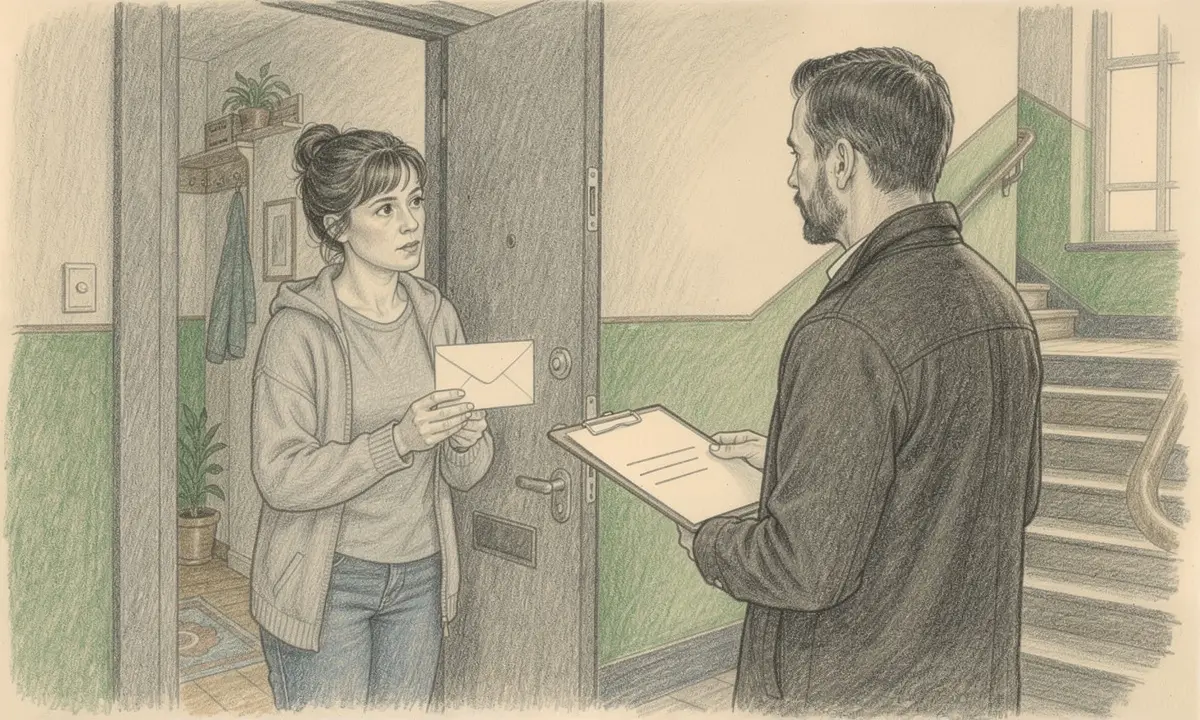
Landlords choose forfeiture when they believe they have evidence and want to proceed quickly. They choose termination at the end of the lease term when the ground is weaker or when it concerns the property rather than you. Sometimes they do both simultaneously for safety. Your first task is to determine which track you are on, as the timelines, forum, and defense differ. Your second task is not to do what the landlord hopes: move voluntarily.
Which document have you received?
The formal requirements that often invalidate the termination
The twelve grounds for forfeiture – and what is required for each
The tenancy is forfeited only in the cases listed by law (Section 42, first paragraph). Here are the grounds that affect residential tenants, with what the landlord must demonstrate:
- Rent arrears (point 1): you have delayed the rent by more than a week after the due date. Can be remedied through recovery within three weeks (Section 44), see below. Exception when the delay concerns a disputed increase under review (Section 44, third paragraph).
- Unauthorized subletting or transfer (point 3): you have rented out for independent use or placed someone else in your place without consent or permission, and lack a valid excuse. No notice is required. The landlord must terminate within six months from knowledge, but no later than six months after the subletting ceased (Section 43, second paragraph). Read subletting.
- Black market trade (point 5): you have given, received, or demanded special compensation for the tenancy. Also a crime (Sections 65–65b). Six-month period from knowledge, but no later than five years after the event.
- Unreasonable subletting rent (point 6): you have charged more than your rent plus a maximum of 15 percent for furniture and actual costs otherwise (Section 55, fourth paragraph), without a valid excuse. Also a crime (Section 65c). Six months.
- Use contrary to the agreement or too many occupants (point 7, compare Sections 23 and 41): requires notice and that correction is not made without delay.
- Vermin (point 8): you have caused vermin through negligence or not reported it so that it spread. The landlord must terminate within two months from knowledge (Section 43, first paragraph).
- Neglect, lack of care, disturbances, or lack of supervision (point 9): requires notice and that correction is not made without delay, and notification to the social welfare board before termination (third paragraph). Exception in particularly serious cases (fourth paragraph). Read notice of correction.
- Denied access (point 10): you have denied the landlord access contrary to Section 26 without a valid excuse. Correction before termination saves (Section 43).
- Breach of contract terms of particular importance (point 11): an obligation beyond the law that is of particular importance to the landlord. Rarely fulfilled for pet bans or smoking bans. Two-month period.
- Serious criminal activity from the apartment (point 12): the apartment is used for serious criminal activity or for habitual or extensive crime. Six months from knowledge, extended if prosecution is initiated or investigation commenced (Section 43, third paragraph).
Rent arrears and recovery – the clock that saves the most contracts
Unpaid rent is the most common ground for forfeiture and the only one with its own rescue rule. Here's how it works:
Two additional protections: you cannot be evicted from the apartment if the social welfare board within the deadline has committed in writing to assume payment responsibility for the rent, or if you were prevented from paying within the deadline due to illness or a similar unforeseen circumstance and paid as soon as possible, but no later than when the eviction dispute is resolved in the first instance (Section 44, fourth paragraph). Contact social services immediately if you cannot obtain the money – financial assistance for rent arrears to prevent eviction is a common measure, and the commitment must come within three weeks.
The landlord's own deadlines
The law does not only give you deadlines. The landlord loses the right to forfeit if they wait too long (Section 43): two months from knowledge for vermin and breaches of contract of particular importance, and to demand in cases of unauthorized subletting of premises; six months from knowledge for unauthorized subletting, unreasonable subletting rent, and criminality, but no later than six months after the subletting ended; five years as the ultimate limit for black market dealings. A landlord who “knew since spring” but terminates in the fall has often exhausted the grounds. Therefore, always document when the landlord knew or should have known – an email, a call, an inspection.
Termination at the end of the lease term
Here, you are not accused of a breach of contract. The landlord wants the agreement to end at the lease term's conclusion—usually three months after the termination—and must have one of the exceptions in Chapter 46, first paragraph: that you have neglected your obligations to such an extent that the agreement reasonably should not be extended (point 2), demolition (3), major renovation (4), that the apartment will no longer be a residence (5), that the landlord intends to live in a single or two-family house or condominium (6–7), service apartment (8–9), or that it otherwise does not violate good practice or is unreasonable against you for the agreement to end (10). The assessment is a balancing of reasonableness where your need for the residence is weighed against the landlord's reasons. Details can be found in security of tenure.
Where the dispute goes
- Extension dispute (termination at the end of the lease term): the Rent Tribunal, at the landlord's application. The tribunal's decision can be appealed to the Svea Court of Appeal within three weeks. A decision that you must move is an enforceable title.
- Forfeiture: the landlord must either file a lawsuit in the district court with a claim for eviction or apply for ordinary assistance with the Enforcement Authority. If you contest the assistance in time, the case goes to the district court if the landlord requests it. The Rent Tribunal can mediate but not decide. Read eviction and the Enforcement Authority.
- Disturbance disputes should be handled expeditiously regardless of the forum (Section 72).
In the case of forfeiture, the landlord also has the right to damages for the damage caused by the termination—in practice, rent for the time until the apartment is rented out again (Section 42, sixth paragraph). In the case of ordinary termination, there is no such right.
Do this
Template Template: contesting termination
To: [landlord], copy: [Tenants’ Association if member]
Subject: Contesting termination dated [date], apartment [address, number]

On [date] I [was served / received in the mailbox] your termination of the lease for the above apartment.

I contest the termination and intend to stay. The grounds for my contesting are:
1. [Formal error: the termination has not been served in the manner required for forfeiture / lacks stated reason / has not been addressed to all tenants / states incorrect timing.]
2. [Lack of grounds: the alleged disturbances have not occurred / are of minor significance / no warning according to Chapter 12, Section 25 a has been given / the social welfare board has not been notified.]
3. [Correction: the alleged condition ceased on [date], before the termination (Chapter 12, Section 43).]
4. [Rent arrears: the amount [x] SEK was paid on [date], within the recovery period according to Chapter 12, Section 44 – receipt attached.]
5. [Deadline: the landlord has been aware of the condition since [date] and has therefore lost the right to invoke it (Chapter 12, Section 43).]

I request that you specify in writing the circumstances relied upon, with dates, and provide the basis you rely on.

I continue to pay the rent on the due date. In the event you maintain the termination, I will assert my objections in the rent tribunal or district court.

[Name, personal identification number, date]
Frequently Asked Questions
Do I have to move on the date stated in the termination?
No. In the case of termination at the end of the lease period, you remain until the Rent Tribunal has resolved the dispute (Section 50), and the landlord must take it there within a month. In the case of forfeiture, the agreement formally ends, but no one can evict you without a judgment or decision and enforcement by the Swedish Enforcement Authority. Moving "voluntarily" removes your objections and may still leave you with rent debt.
Can the landlord invoke multiple grounds simultaneously?
Yes, it is common for a termination to mention both rent arrears and disturbances, or for the landlord to terminate both prematurely and at the end of the lease period. Address each ground separately. A weak disturbance act does not become stronger just because it also stated "rent arrears" if the debt is paid within the deadline.
What happens if I just leave the keys and move out?
Then you are considered to have accepted that the agreement has ended. You lose the opportunity to contest the termination, may be liable for rent until the landlord rents out again, and are disadvantaged in the housing queue as you lack a reference. Talk to an advisor before giving up the apartment – even if you plan to move, it is better to do so through an agreement where the landlord waives claims.
I paid the rent two days late once. Is the contract forfeited?
No. Forfeiture due to rent arrears requires more than a week's delay (Section 42, first paragraph 1), and a single short delay is also of minor importance (fifth paragraph). However, repeated late payments can become "neglect of obligations" in an extension dispute – pay on time, and set up direct debit if possible.
The landlord offers me money if I move. Should I take it?
Maybe – but not in the doorway. The offer means that the landlord considers the termination uncertain. Calculate what the security of tenure is worth to you: rent difference compared to a new residence over several years, moving costs, waiting time. Take the offer to an advisor and demand that it be written as an agreement where the landlord waives all claims and provides a neutral reference.
Sources
- Jordabalken Chapter 12, Section 42 – Grounds for forfeiture
- Jordabalken Chapter 12, Section 43 – Rectification and landlord's deadlines
- Jordabalken Chapter 12, Section 44 – Recovery in case of rent arrears
- Jordabalken Chapter 12, Section 46 – Right to extension
- Jordabalken Chapter 12, Sections 49–50 – Referral and right to remain
- Jordabalken Chapter 12, Sections 4–8 – Notice period, form, and service
- Service of Process Act (2010:1932)
- Rent Tribunal
- Kronofogden: eviction
The guide is general information about applicable rules, not advice on your case. If you rent from a private individual who owns the residence, from July 1, 2026, the Private Rental Act will apply instead of Chapter 12 of the Jordabalken in several respects. Legal status checked on September 25, 2026.
For those reading under stress
The guide is intended as support when you already have a lot on your mind. You do not need to read everything at once: start with the section that matches where you are today and return when the next step becomes relevant.
Matters with authorities rarely improve by handling everything alone. Ask for help from a support person, lawyer, or relative if you can – especially before decisions with long-term effects.
Common mistakes that make the case more difficult
- Relying only on verbal promises without brief written confirmation or follow-up email.
- Waiting to request documents until the conflict is already locked – then it becomes harder to show what was said.
- Writing so long and emotionally that the authority stops responding to the substantive issue.
- Missing deadlines for reconsideration or appeal because the decision was not read verbatim.
Mini-checklist before you leave the guide
- Do I have the date, diary/case number, and name of the person handling the case (if you know)?
- Do I know what the next step is: respond, request, remind, appeal, or report?
- Have I saved emails and attachments in a place where I can find them in a week?