This guide is informational. Always verify how the rules apply to your specific case.
You are here: 7/7
Last reviewed on October 5, 2026. If you wish to change the decision itself, you should primarily appeal or request a reconsideration (e.g. appeal Försäkringskassan or Sickness compensation and work 2026). If the issue concerns how the case has been handled, such as missing responses, incorrect notes, or unclear information, the Parliamentary Ombudsman (JO) is the appropriate avenue. Related: Report of Concern for a ChildI'm sorry, it seems there was an error in your request. Could you please provide the Swedish legal-information text you would like translated into English? Report of Concern for an AdultI'm sorry, but it seems there is no text provided for translation. Could you please provide the Swedish legal-information text you would like translated into English? Recording a meeting with an authority and Recording the police legally.
When the Parliamentary Ombudsman (JO) does not assist: choose the right path
The JO's own website describes how to file a complaint. This guide supplements what JO.se rarely emphasizes: when a JO complaint is the wrong tool and what you should do instead.
- You wish to change a decision (rejection, LVU, compensation, placement) → request a reconsideration or appeal. The JO does not alter the content of the decision.
- You want compensation → The Parliamentary Ombudsman (JO) does not award compensation. That is a separate matter (e.g., a claim for damages or a specific insurance).
- You are dissatisfied with the substantive issue, but the procedure was formally correct. → The Parliamentary Ombudsman (JO) often dismisses cases. Focus on appeals and new evidence.
- You need urgent protection or care → The Parliamentary Ombudsman (JO) is too slow. Contact emergency services, healthcare, or the police according to the situation.
- The handling is deficient (delay, incorrect records, lack of response) → then the Parliamentary Ombudsman (JO) is appropriate, preferably in parallel with an appeal if the deadline is approaching.
Official e-service: JO's page on complaints. Use it to send. Use this page for templates, consequences, and strategy.
JO Notification: What the Parliamentary Ombudsman Examines
- Delay in the processing or release of documents
- Lack of communication: you are not informed about the subject of the case, or you receive no reasons
- Error in documentation: service notes that are clearly incorrect and are not corrected/commented
- Unprofessional conduct or that the authority does not follow its own procedures
JO Patterns 2025-2026: Documentation and Delays
Several recent cases from the Parliamentary Ombudsman (JO) reveal the same practical pattern: slow processing, inadequate documentation, delayed decisions, and difficulties in obtaining documents. The JO has, among other things, criticized social welfare committees where cases could not be tracked and schools where suspensions or the release of student records were not handled correctly.
For you, this means that a complaint to the Parliamentary Ombudsman (JO) becomes stronger when you can demonstrate a concrete pattern: dates of requests, reminders, lack of responses, incorrect notes, and which decisions or documents are missing.
In-depth and statistics: Read the report on JO complaints 2025, where police cases increased from 1,334 to 1,998. Open the statistics page for developments within police, social services, migration, and education 2021–2025. Registered complaints are not the same as confirmed errors.
JO complaint form: e-service + template to copy
Many search for JO complaint form or jo complaint form. In practice, JO's e-service or complaint form is the most common way to submit the case. The important thing is not the form itself, but that the complaint is clear enough for JO to quickly understand three things: what happened, which authority it concerns, and why you believe the handling was incorrect.
Avoid writing a long story without structure. Instead, write briefly, chronologically, and with attachments showing the key points.
Official entry: JO's page on complaints and e-service. Always save the receipt and case number when you have sent it.
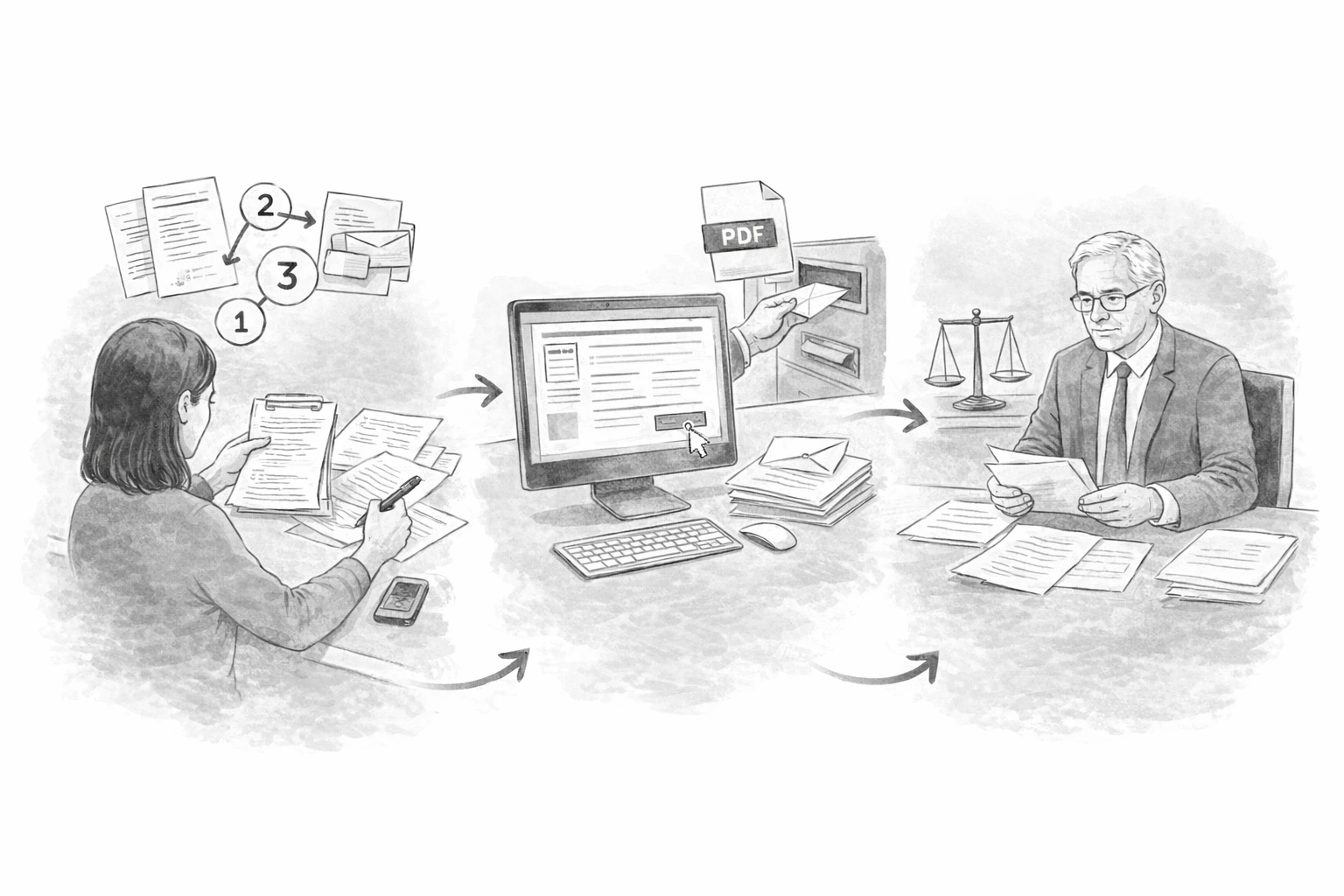
How to make a JO complaint step by step
- Clarify the goal. Do you want to change a decision (appeal/reconsideration) or review the handling (JO)? Both may sometimes be needed, but they should not be mixed in the same text.
- Gather documentation. Decisions, emails, service notes, case numbers, and a simple timeline with dates.
- Write the draft. Use the template below: maximum two pages of main text, the rest as numbered attachments.
- Choose the channel. JO's e-service or complaint form. Attach PDF, not screenshots in unknown formats.
- Send and document. Screenshot or PDF of submission, date, and JO's reference if you receive it.
- Continue in parallel. Remind the authority of missing responses, request decisions in writing, and keep deadlines for appeals if they apply to you.
- Follow up with JO. After a few months, you can inquire about the status with the case number. JO often requests a statement from the authority before making a decision.
JO complaint consequences: what can happen for you and the authority?
Many search for jo complaint consequences to know if the complaint "punishes" them or forces the authority to change a decision. JO focuses on how the authority handled the case, not on becoming your party in the dispute over the content.
- For you: You may receive written notice that JO dismisses, requests a statement, or examines more closely. Criticism from JO can support further contacts with the authority, in the media, or in other inspections, but rarely results in money or a new decision in your case.
- For the authority: Criticism, recommendations, or a call to change routines. Sometimes followed by internal follow-up or training.
- For ongoing cases: A JO complaint does not replace responding to orders, appealing on time, or requesting documents. Do both if both are needed.
- Damages: JO does not award compensation. Damages, discrimination, or criminal complaints are other avenues.
A common misconception is that JO "stops" social services or Försäkringskassan. It may happen that the handling becomes more formal after a complaint, but that is not the same as winning the case regarding the decision itself.
JO complaint vs appeal vs IMY
| Track | Suitable when | Typical effect |
|---|---|---|
| Appeal / reconsideration | You want to change a decision (compensation, placement, rejection) | New examination of the content |
| JO complaint | Delays, poor justification, incorrect documentation, unreasonable treatment | Criticism, supervision, sometimes dismissal |
| IMY | Personal data handled incorrectly (e.g., dissemination, incorrect register) | Supervision according to GDPR, no damages via IMY |
Unsure? Read where to turn and appeal a government decision before you lock in the strategy.
JO complaint against social services, police, and the Swedish Migration Agency
The same basic rules apply, but the documentation differs. Always specify the correct authority and unit (municipality, police region, Swedish Migration Agency office).
JO complaint social services
Common reasons: no response to requests for documents, meetings without a clear description of what is being investigated, service notes that do not match what was said, or not being informed about what the concern report involves. After a concern report about children, there are also statutory time limits that JO examines: preliminary assessment within 14 days, investigation completed within four months, and information to you immediately when the investigation begins (Chapter 20, Sections 2–4 of the Social Services Act). If these are exceeded without a documented decision for extension, it is a concrete JO ground. JO does not change LVU decisions; for that, an appeal is needed. Often combine JO with request for documents and correction in the investigation. In case of a concern report, see concern report children: what happens and respond to a report to social services.
JO complaint school
JO reviews municipal schools and principals, but not independent schools; for them, the Swedish Schools Inspectorate is the correct supervision. Common JO grounds are delays in providing student records or action plans, suspensions without proper decision, and the school's delay in making a concern report that it was obliged to make immediately. What the school must do is described in concern report from the school.
JO complaint police
Suitable when the handling of a report, register issues, or documentation is lacking, not when you want to "win" a criminal investigation. Describe the case number, date of the report, if you received written notification, and if register extracts or decisions have been delayed. Connect to public document if you have not received information you are entitled to.
JO complaint Swedish Migration Agency
Common in cases of delays, unclear communication, lack of justification in decisions, or difficulty obtaining documents in ongoing cases. JO does not replace the migration court's examination. Keep the JO text brief about handling errors and save the content dispute for appeal.
Legal support to mention (make the complaint concrete)
You do not need to write like a lawyer, but a clear reference to the law helps JO understand what you mean:
- Administrative Procedure Act (2017:900): principles of good administration (Sections 5–8), prompt processing (Section 9), party insight (Section 10), delay action (Section 12), investigative responsibility (Section 23), communication (Section 25), reasoning (Section 32), and correction and amendment of decisions (Sections 36–38).
- Social Services Act (2025:400): protection assessment, preliminary assessment within 14 days, investigation within four months, and information to those concerned (Chapter 20, Sections 1–4), documentation and noting of incorrect information (Chapter 14, Sections 3 and 6).
- Principle of Public Access: if you have not received documents or received a delayed response to your request.
- Confidentiality: if you believe that information has been shared in violation of confidentiality or that you have not been informed about the subject of the investigation.
- Authority-specific regulations: e.g., Social Services Act for children, Patient Act for healthcare, Administrative Procedure Act for the Swedish Social Insurance Agency.
Preparations before you send
- Gather case numbers, decisions, and any correspondence.
- Describe the sequence of events chronologically and maintain an objective tone.
- Explain which legal rule you believe the authority has violated.
- Indicate if the matter is still ongoing; the Parliamentary Ombudsman (JO) can act more quickly in ongoing errors.
Parliamentary Ombudsman (JO) complaint template: text to copy
- Title: Parliamentary Ombudsman (JO) complaint against [authority/municipality] regarding [brief issue].
- Who is it about? Authority, case officer if you know the name, case number, and date.
- What happened? Describe the events in chronological order with short paragraphs.
- What is the error? For example, delay, lack of communication, incorrect handling, lack of reasoning, or incorrect documentation.
- What have you done? Reminders, requests for decisions, requests for correction, appeals, or other contact.
- What do you want the Parliamentary Ombudsman (JO) to review? Formulate one or two clear questions.
- Attachments: Decisions, emails, service notes, timeline, and other documents that directly show the problem.
Submit the complaint without losing focus
- Use the Parliamentary Ombudsman (JO)'s e-service or form and attach only relevant attachments as PDFs.
- Request a receipt and save the case number.
- Inform your representative, support person, or the person assisting you with the matter so that strategies do not conflict.
What does a Parliamentary Ombudsman (JO) complaint lead to?
A Parliamentary Ombudsman (JO) complaint does not automatically lead to a full review. The JO may dismiss the case, request a statement from the authority, or examine the issue more closely. If the JO finds that the authority acted incorrectly, the decision may result in criticism. Such criticism can be important for you, for the authority's procedures, and for others in similar situations, but it does not replace an appeal.
- The Parliamentary Ombudsman (JO) can criticize the authority or a handling process.
- The Parliamentary Ombudsman (JO) cannot change your decision in the same way as a court or higher instance.
- The Parliamentary Ombudsman (JO) does not normally award damages; such claims are handled in other ways.
- The Parliamentary Ombudsman (JO) can use your complaint as part of broader supervision even if you do not achieve the effect you hoped for.
Example text you can adapt (JO complaint)
JO complaint against [municipality/authority] regarding [brief case description]
I am reporting the handling of case [case number]. Since [date], [authority] has [brief description of events].
Chronology:
[date]: I requested [document/decision].
[date]: No response / response without decision.
[date]: [meeting/conversation] where [brief content]. Appendix 2: recording/transcription if applicable.Handling errors: Delay without reasonable explanation (Section 9 of the Administrative Procedure Act), lack of justification (Section 32 of the Administrative Procedure Act), incorrect service notes not corrected or commented on despite request (Section 36 of the Administrative Procedure Act and Chapter 14, Section 6 of the Social Services Act).
What I have requested: Decision in writing on [date], release of [document], correction of note [date].
What I want JO to review: Whether the authority has failed in good administration and whether procedures for documentation and responses have been followed.
Attachments: 1) timeline, 2) emails, 3) decision/lack of decision, 4) relevant notes.
Common mistakes
- Confusing a JO complaint with an appeal of a decision.
- Sending the entire file without highlighting the most important attachments.
- Focusing on the feeling of injustice but not showing concrete handling errors.
- Omitting dates, case numbers, and what you have already requested from the authority.
- Waiting too long while the issue is still ongoing and can be documented.
- Threatening with JO in emails to the case officer instead of sending a factual complaint to JO.
Common questions about JO complaints
What is a JO complaint?
A complaint to the Justitieombudsmannen about an authority's failure in handling, delay, treatment, or documentation. JO reviews how the case was managed, not whether you are "right" in the substantive issue.
How do you make a JO complaint?
Go to JO's e-service or complaint form, write a brief chronology with dates and case numbers, attach PDF attachments, and save the receipt. Use the template above if you want structure.
Is there a specific JO complaint form?
The Parliamentary Ombudsman (JO) offers e-services and forms. This appears in search results as "JO complaint form." You do not need legal terminology, but you need structure: date, authority, what happened, what is wrong, and which attachments demonstrate this.
When does JO not help?
When your primary goal is to change a decision, obtain compensation, or secure urgent protection. In such cases, appeal, reconsideration, compensation claims, or emergency/care are more appropriate. JO is suitable when there are deficiencies in the handling of the case.
What are the consequences of a JO complaint?
For you: a possible written response, sometimes criticism that can support further contacts. For the authority: criticism or changes in routine. JO does not change decisions or pay compensation.
Can I get compensation through JO?
No. JO does not award compensation but can criticize the authority. Compensation claims are pursued separately.
How long does a JO complaint take?
Anywhere from a few months to over a year, depending on priority, scope, and whether JO requests a statement.
What does a JO complaint lead to?
Usually, JO first assesses whether the case should be reviewed. In some cases, JO requests a statement from the authority and may later issue criticism.
Can I file a JO complaint anonymously?
Yes, but then JO cannot provide feedback as easily.
Can a JO complaint affect my ongoing case?
It can draw attention to the handling, but it does not replace deadlines, appeals, or reconsideration. Monitor the case itself in parallel.
Should I first request documents?
Often yes. Documents, emails, and service notes make the complaint more concrete. See the guide on requesting public documents.
JO complaint against social services: when is it appropriate?
When there are deficiencies in handling: lack of response, unclear information about what is being investigated, incorrect service notes, delays, or exceeded time limits after a report of concern (14 days for preliminary assessment, four months for investigation). JO does not change LVU or assistance decisions. In such cases, you should appeal in parallel.
Can I file a JO complaint against Försäkringskassan or social services?
Yes, if the handling has been deficient. If you want to change a denial of sickness compensation, you first need to follow reconsideration and appeal and check which rule applies in 2026.
Does recording meetings help?
Yes. A JO complaint becomes clearer if you can show what was said compared to the service notes.
Structure that works in practice
- Timeline: dates and case numbers in chronological order.
- Legal provisions: e.g., Section 9, Section 23, or Section 32 of the Administrative Procedure Act, or Chapter 20 of the Social Services Act if applicable.
- Attachments: only what shows the error, not the entire file.
- Reminder: after three to four months, you can ask the Parliamentary Ombudsman (JO) about the status with the case number.
Sources
For those reading under stress
The guide is intended as support when you already have a lot on your mind. You do not need to read everything at once: start with the section that matches where you are today and return when the next step becomes relevant.
Cases with authorities rarely improve by carrying everything alone. Ask for help from a support person, lawyer, or relative if you can – especially before decisions with long-term effects.
Common mistakes that make the case more difficult
- Relying only on verbal promises without brief written confirmation or follow-up email.
- Waiting to request documents until the conflict is already locked – then it becomes harder to show what was said.
- Writing so long and emotionally that the authority stops responding to the substantive issue.
- Missing deadlines for reconsideration or appeal because the decision was not read verbatim.
Mini-checklist before you leave the guide
- Do I have the date, case/reference number, and name of the person handling the case (if you know)?
- Do I know what the next step is: respond, request, remind, appeal, or report?
- Have I saved emails and attachments in a place where I can find them in a week?
Bonus (updated 2026): Integrity and rights against authorities 2026: what has changed?