This guide is informational. Always verify how the rules apply to your specific case.
You are here: 3/7
Last reviewed October 5, 2026.
What is a public document?
A public document is a document held by an authority and not exempted according to the Public Access to Information and Secrecy Act. It can be emails, decisions, service notes, minutes, journal entries, or audio and film that the authority stores.
Everyone has the right to request public documents. You usually do not need to explain why. Specify which document or case you mean, the desired format (usually PDF via email), and your contact details if they need to reach you.
Requesting documents, request for public document, and public document are different terms for the same right: the principle of public access in Chapter 2 of the Freedom of the Press Act. The authority should release the document immediately or as soon as possible, in practice within a day or two.
When does a document become public?
A document is generally public when it is received or created by the authority. Certain drafts and working materials may be exempt. If the authority denies, you should receive a written decision with legal support so you can appeal.
- Public: decisions, emails to and from the authority, meeting notes that have been registered, received reports of concern (sometimes redacted).
- Often not public immediately: pure drafts that have not been dispatched, certain internal memos before they become documents.
- Secrecy: parts can be redacted but must be tested; you should not receive a general no without justification.
The principle of public access in practice
Requests can be oral but are almost always written for traceability. Save a copy, request a registration number, and ask for information about any fee before release.
Update 2026: independent schools, secrecy, and information sharing
Two changes are particularly important to know when requesting authority documents. First, on May 26, 2026, the Riksdag decided that the principle of public access will be introduced for private operators in the school system from January 1, 2027. Independent schools will then be required to register and release public documents in the same way as municipal schools. Smaller operators, with a maximum of 450 children and students or a maximum of 100 children in preschool only, will receive relief rules, and the rules will be phased in during 2027 and 2028. Until then, only the rules of the Education Act apply, which state that guardians should have insight into their child's documentation.
Second, from December 1, 2025, a new provision breaking secrecy applies, making it easier for authorities to share information with each other to counteract crime, incorrect payments, fraud, and regulatory violations. When information starts to move between authorities, it becomes even more important to request the underlying documents and verify the source of claims.
- School system: Prop. 2025/26:191, adopted May 26, 2026
- Information sharing: New provision breaking secrecy from December 1, 2025
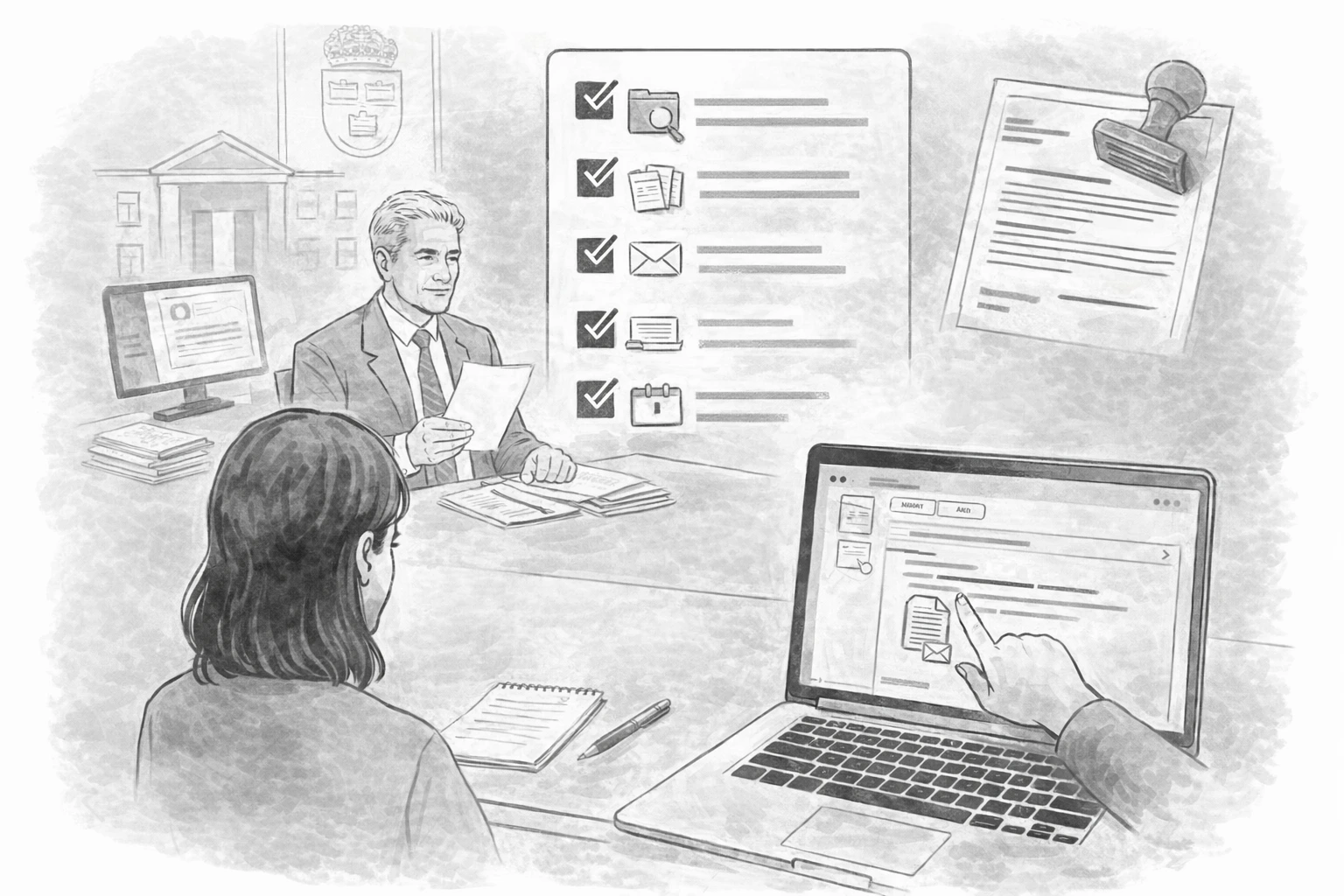
Quick Checklist (60 seconds)
- Identify the case: case number, date, location, case officer.
- Request “all documents” + specify examples (notes, memos, decisions, attachments).
- Request a digital copy and ask for information about any potential fee before release.
- Request a written decision if they deny completely or partially (so you can have it reviewed).
- Log everything: date, channel, whom you contacted, and the response you received.
Content
- Police: incident report after check
- Social Services: investigation and journal notes
- School: student file and action plan
- Försäkringskassan: decision basis
- Municipality and committees: decisions and minutes
- Healthcare and records
Formulate the request
- Identify the case number, meeting date, or case title.
- Request a digital copy via email for quick delivery.
- Keep a record of when and how you sent the request.
- Feel free to request journal notes, meeting invitations, and decision bases at the same time.
Handle confidentiality
The authority must conduct a confidentiality assessment. Request a written decision upon denial and appeal within the specified time (often three weeks). If the authority delays: remind them in writing and request a formal decision.
Party access: when the case concerns yourself
The principle of public access applies to everyone. If you are also a party in a case, for example, a guardian in an investigation following a report of concern or an applicant with Försäkringskassan, you have a stronger right: party access according to Section 10 of the Administrative Procedure Act. You are then entitled to access everything added to the case, even information that is otherwise confidential, as long as it is not of particular importance to keep the information secret (Chapter 10, Section 3 of the Public Access to Information and Secrecy Act). Therefore, explicitly state that you request the documents as a party when the case concerns you.
For reports of concern, this means in practice:
- You have the right to read the report, preliminary assessment, journal notes, and investigation plan in your child's case.
- Reporters who have reported in their professional capacity, such as schools, preschools, and healthcare, are normally not confidential to you.
- Information about a private individual who reported can be redacted if the person is at risk of violence or other serious harm (Chapter 26, Section 5 of the Public Access to Information and Secrecy Act). You should still receive the rest of the report.
- Information concerning other individuals, such as the other parent or the child's own conversations, can be partially redacted. Then request a written decision with legal grounds.
How you use the documents when responding is described in report of concern for children: what happens and respond to report of concern. If the report comes from the school, also read report of concern from the school about what the school must document and disclose.
Example: different authorities and what you can request
Below are examples of common situations where private individuals want to access documents. Always adjust details (date, location, case number) according to your own case.
Police: incident report after check
After a traffic check or other contact with the police, you can request the incident report, notes, and other documentation.
- What: Incident report, service notes, any video or audio material if available.
- Who: The Police Authority's registrar (via e-service or the authority's specified email address).
- Tips: Specify the date, approximate time, location, and if possible, patrol number or car number.
Template for the police:
Subject: Request for public document, incident report

To the Police Authority,

I wish to request the following public documents under the Freedom of the Press Act:

- Incident report and documentation related to the event on [date] around [time] in [location]
  where I was stopped by a police patrol.
- Any service notes, memos, or other notes related to the same event.

I wish to receive the documents digitally via email. If parts are subject to confidentiality,
I request a written decision with reference to the applicable paragraph.

Kind regards,
[Name]
[Personal identification number, optional]
[Contact information]
Social services: investigation and journal notes
During an ongoing or completed investigation, you can request journal notes, decision-making documents, and meeting minutes.
- What: Journal notes, decision documents, meeting materials, received report of concern (possibly redacted).
- Who: The registrar of the social services or the committee responsible for the case.
- Tips: Provide the child's name, personal identification number, and case number if you have it. State that you are requesting the documents as a party if the case concerns you or your child.
Template for social services (also available as a fillable template: request for documents from social services):
Subject: Request for public document, case concerning [child's name]

To [municipality's name] social services,

I wish to request all documentation in the case concerning [child's name, personal identification number] during the period [from] to [to], including:

- Journal notes and decision documents.
- Summaries and internal memos.
- Received report of concern and any statements from the school or other parties.

I wish to receive the documents digitally via email. If parts are subject to confidentiality,
I request a written decision with reference to the relevant paragraph.

Kind regards,
[Name]
[Relation to the child]
[Contact information]
School: student record, action plan, and notes
As a guardian, you can request the student record to see how the school has documented concerns, actions, and contacts.
- What: Student record, notes from meetings, action programs, action plans, emails concerning the student.
- Who: The school's principal or the registrar of the responsible authority. For independent schools, the principle of public access applies from January 1, 2027; until then, refer to your right to insight as a guardian.
Template for the school (also available as a fillable template: request for student record from the school):
Subject: Request for public document, student record for [student's name]

To [school's name/principal],

I wish to request the student record and documentation concerning [student's name, personal identification number], including:

- Notes from meetings with guardians.
- Action programs, action plans, and investigations.
- Internal notes and emails concerning the student's situation.

The documents are requested in digital form via email. In case of any confidentiality, please
provide a written decision with legal support.

Kind regards,
[Name]
[Contact information]
Försäkringskassan: decision basis
When considering a review or appeal, it is important to see what basis Försäkringskassan has used.
- What: Service notes, internal assessments, received medical opinions, decision memoranda.
- Who: Försäkringskassan via their e-service or registrar.
Template for Försäkringskassan:
Subject: Request for public document, basis in case [case number]

To Försäkringskassan,

I wish to request, under the Freedom of the Press Act, all documents that
form the basis for the decision in case [case number], including:

- Service notes and internal assessments.
- Received medical documents and any supplements.
- Decision memoranda and summaries.

The documents are requested in digital form via email. In case of a confidentiality request, I wish
a written decision with reference to applicable legal provisions.

Kind regards,
[Name]
[Personal identification number]
[Contact information]
Municipality and committees: decisions and minutes
Municipal decisions, committee minutes, and service statements are generally public.
- What: Minutes, decision basis, service statements, delegation decisions.
- Who: The municipality's registrar or the committee's office.
Healthcare and records
Patient records are normally requested via the healthcare provider, but are also public documents in many regions.
- What: Journal notes, test results, referrals, care plans.
- Who: The healthcare provider's record service, the region's e-service, or registrar.
Practical strategies
- Request a diary list or case number first if you do not know what is available.
- Combine "all documents in case X" with a bullet list of known documents.
- In case of partial denial: appeal the specific confidentiality, not the entire request at once.
Frequently asked questions about public documents
What is the difference between a public document and an official document?
In everyday language, the terms are used interchangeably. In legal text, "public document" is the central term. A public document is official if it is not covered by confidentiality.
Can I remain anonymous?
Yes, as long as you do not require physical mail that requires a name and address. The authority may not ask who you are or why you want the document, except when necessary for the confidentiality assessment.
Can the authority charge a fee?
Yes, but often only after ten pages. Request a cost estimate before you approve. Digital copies are often free of charge.
How quickly must the authority respond?
The document should be provided immediately or as soon as possible. A few days of processing is normal; weeks are not. Remind in writing and request a formal decision if you do not receive a response.
Can I read the report of concern made about my child?
Yes, generally. As a guardian, you are a party and have the right to insight into the case. Information about a private individual who reported can be redacted if the person risks violence or serious harm. Schools, healthcare, and others who reported in their official capacity are normally not confidential.
What should I do in case of delay?
Remind in writing, request a formal decision and read when the authority does not respond. In case of prolonged delay, a JO report may be relevant.
Can I request documents from an independent school?
From January 1, 2027, the principle of public access will also apply to private operators, with phasing in for smaller operators during 2027 and 2028. Until then, as a guardian, you can request insight into your child's documentation under the Education Act.
For those reading under stress
The guide is intended as support when you already have a lot on your mind. You do not need to read everything at once: start with the section that matches where you are today and return when the next step becomes relevant.
Matters with authorities rarely improve if you handle everything alone. Ask for help from a support person, lawyer, or relative if you can – especially before decisions with long-term effects.
Common mistakes that make the case more difficult
- Relying only on verbal promises without brief written confirmation or follow-up email.
- Waiting to request documents until the conflict is already locked – then it becomes harder to show what was said.
- Writing so long and emotionally that the authority stops responding to the substantive issue.
- Missing deadlines for reconsideration or appeal because the decision was not read verbatim.
Mini-checklist before you leave the guide
- Do I have the date, diary/case number, and name of the person handling the case (if you know)?
- Do I know what the next step is: respond, request, remind, appeal, or report?
- Have I saved emails and attachments in a place where I can find them in a week?
Bonus (updated 2026): Privacy and rights against authorities 2026: what has changed?